Surgeon-led care
The surgeon who plans your case performs it — harvest, site creation and the final graft. You are not handed to a technician after the consultation.
1000 Dove St #250, Newport Beach, CA 92660
Why patients choose NHT
Hair restoration is decided long before the first incision. These are the points where our approach diverges from the industry default.
The surgeon who plans your case performs it — harvest, site creation and the final graft. You are not handed to a technician after the consultation.
FUT 2.0 and the HUMS healing protocol were developed here, refined over three decades of operating on nothing but hair.
We plan to a measured density target for the area you care about, because coverage — not graft count — is what the mirror shows.
Nerve blocks numb the whole field before work starts, with optional twilight sedation. Most patients feel the first injection and nothing after it.
Technique
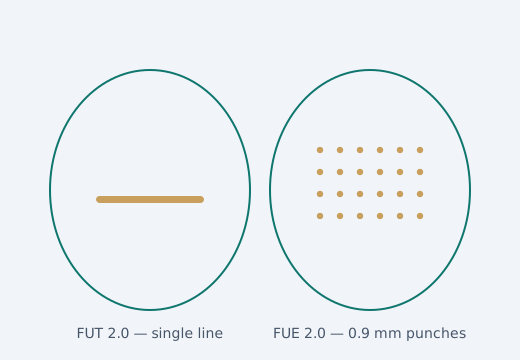
FUT 2.0 moves the most hair in a single sitting, closing the donor site as one fine line that surrounding hair covers. It suits patients who want maximum density now and who do not shave the back of the head to the skin.
FUE 2.0 removes follicular units individually through a 0.9 mm punch, leaving no linear scar at the cost of a wider scattered donor footprint and a lower per-session yield. It suits short clippered styles and smaller targeted cases.
Most honest plans use one or the other for a clear reason. We will tell you which, and why, before money changes hands.
Services
Surgical and non-surgical options, all planned in the same consultation.
A no-obligation evaluation of your donor supply, loss pattern and realistic density target. In person in Newport Beach or by video.
FUT 2.0 and FUE 2.0 surgery planned around the density you want, delivered in a single surgeon-led session.
Platelet-rich plasma drawn from your own blood and injected into thinning areas to support existing follicles.
Non-surgical pigment deposits that read as closely cropped hair — for density illusion, scar camouflage or a clean shaved look.
Results
Our gallery is sorted by the density increase achieved rather than by graft count, so you can find cases that match the result you are actually after.
The clinic

Founder & Hair Restoration Surgeon
M.D. · 30+ years exclusively in hair restoration · 10 ISHRS annual meeting presentations
Patient words
“I went to three consultations. Two of them quoted me a graft number in the first ten minutes. This was the only place that measured anything before quoting, and the only one that told me what my donor area could not do.”
“Surgery day was far duller than I expected, which is exactly what you want. I felt the first injection and nothing after it. Back at my desk on the Thursday.”
“My part had been widening for years and I had been told repeatedly that women are not good candidates. The planning here was about my hairline specifically, not a generic male pattern plan applied to me.”
“I had work done elsewhere in 2011 that I spent a decade hiding under hats. The old hairline was rebuilt and the donor scar camouflaged. It just looks like hair now.”
Questions
Yes, within the limits of your donor supply. Hair taken from the back and sides of the scalp is not sensitive to the hormone that drives pattern loss, so once it is moved it keeps growing on its new site. What a transplant cannot do is create hair you do not have — the donor area is a fixed budget, and good planning is mostly about spending it well.
It is an outpatient procedure done under local anaesthetic with optional light sedation. The risks are the ones that come with any minor skin surgery: temporary swelling, numbness that resolves over weeks, and a small infection risk managed with normal wound care. We review your medical history and medications at consultation and will tell you if surgery is a poor idea for you.
The transplanted follicles are permanent. The hair around them is not — pattern loss continues in untreated areas, which is why we plan the first session with the next ten years in mind rather than filling the most visible gap and hoping.
That depends almost entirely on angle, direction and density. Hair grows out of the scalp at a shallow, consistent angle that changes across the head, and single-hair units belong at the hairline with larger groupings behind them. Get those wrong and the result reads as surgery no matter how many grafts were placed.
The transplanted hairs shed in the first few weeks — this is expected. New growth starts around month three or four, becomes obvious at six months, and keeps thickening through twelve to eighteen months. Judge the result at a year, not at six weeks.
The anaesthesia is the part people dread, so it is the part we have spent the most effort on. Nerve blocks numb the whole field before any work starts, and the great majority of patients report no pain during surgery. Afterwards, a mild over-the-counter painkiller is usually enough.
Neither is universally better. FUT 2.0 moves more hair in one session and leaves a single fine line that hair covers; FUE 2.0 leaves no line but scatters small round scars across a wider donor area and typically yields fewer grafts per session. If you shave your head to the skin, FUE is the safer choice. If you want maximum density in one sitting, FUT usually wins.
That is the wrong first question. Grafts are a unit of supply; density is the unit of result. Two patients with the same graft count can finish with very different coverage depending on area treated and hair calibre. We plan to a density target for the area that matters to you, then work out what graft count that requires.
By the donor area we harvest and the complexity of the plan — not per graft. Per-graft pricing creates an incentive to count generously and to spread grafts thin. A flat price for the plan removes that incentive and tells you the whole cost up front, including follow-up care.
The main requirements are a donor area dense enough to spare hair, a loss pattern stable enough to plan around, general good health, and expectations that match what your donor supply can cover. Age matters less than pattern: an aggressive pattern at 24 needs a different plan from a stable one at 44.
Yes, and the planning differs. Female loss is usually diffuse rather than patterned, so we check for medical causes first, assess whether the donor area is itself thinning, and treat hairline, temples or part-line density accordingly.
Forty-five minutes, no obligation, and you leave with a written plan and a price. In person in Newport Beach or by video anywhere.